Multiple Linear Regression Walkthrough
This walkthrough explores how multiple linear regression (MLR) is used to model and predict student performance based on various academic and lifestyle factors.
📥 Data Import & Description
import pandas as pd
import numpy as np
import seaborn as sns
import matplotlib.pyplot as plt

dataset = pd.read_csv('Student_Performance.csv')
We work with a dataset of 10,000 students, containing:
- 4 continuous variables
- 1 binary categorical variable (Extracurricular Activities)
- 1 target variable (Performance Index)
🔍 Exploratory Data Analysis (EDA)
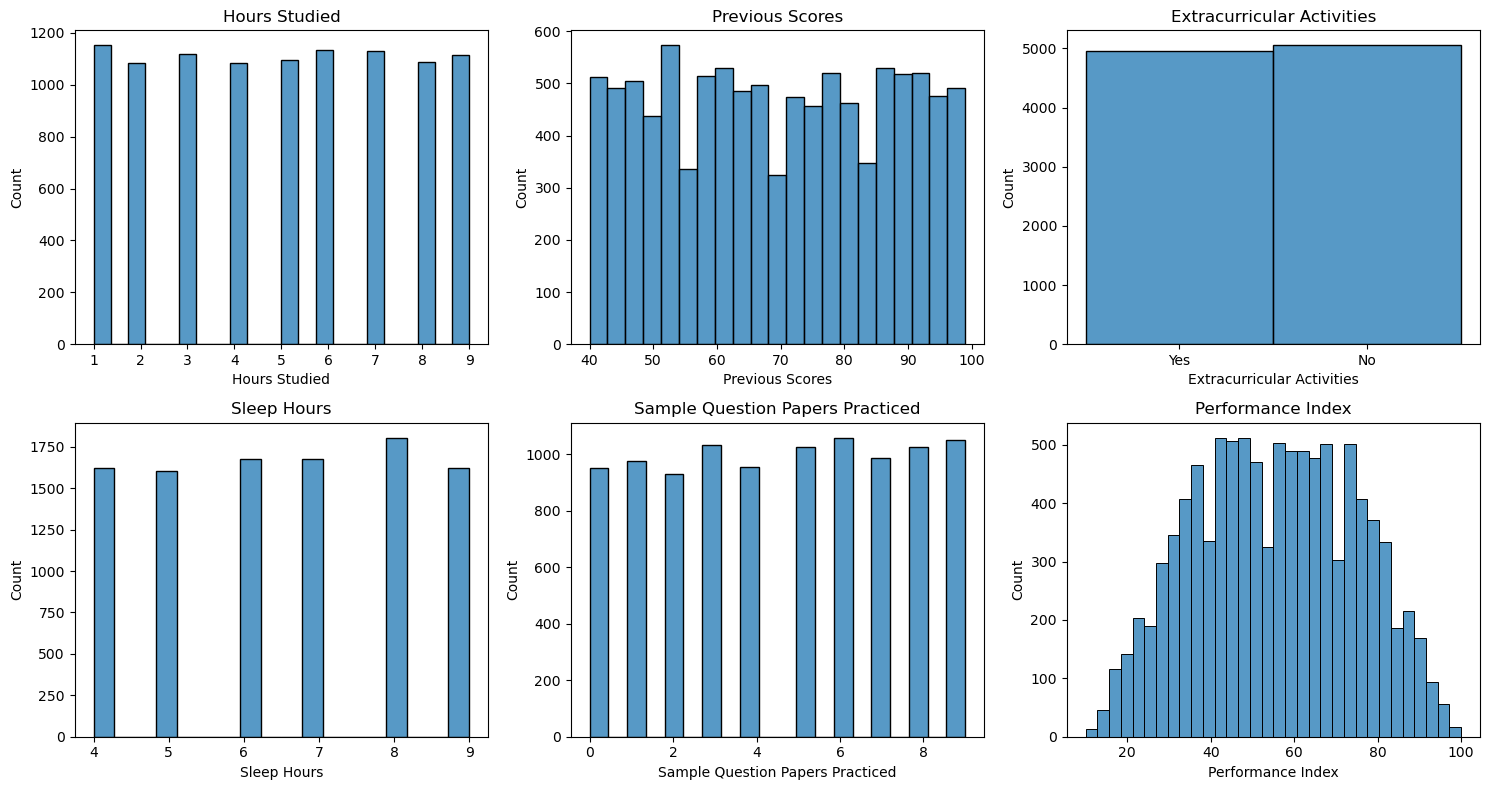
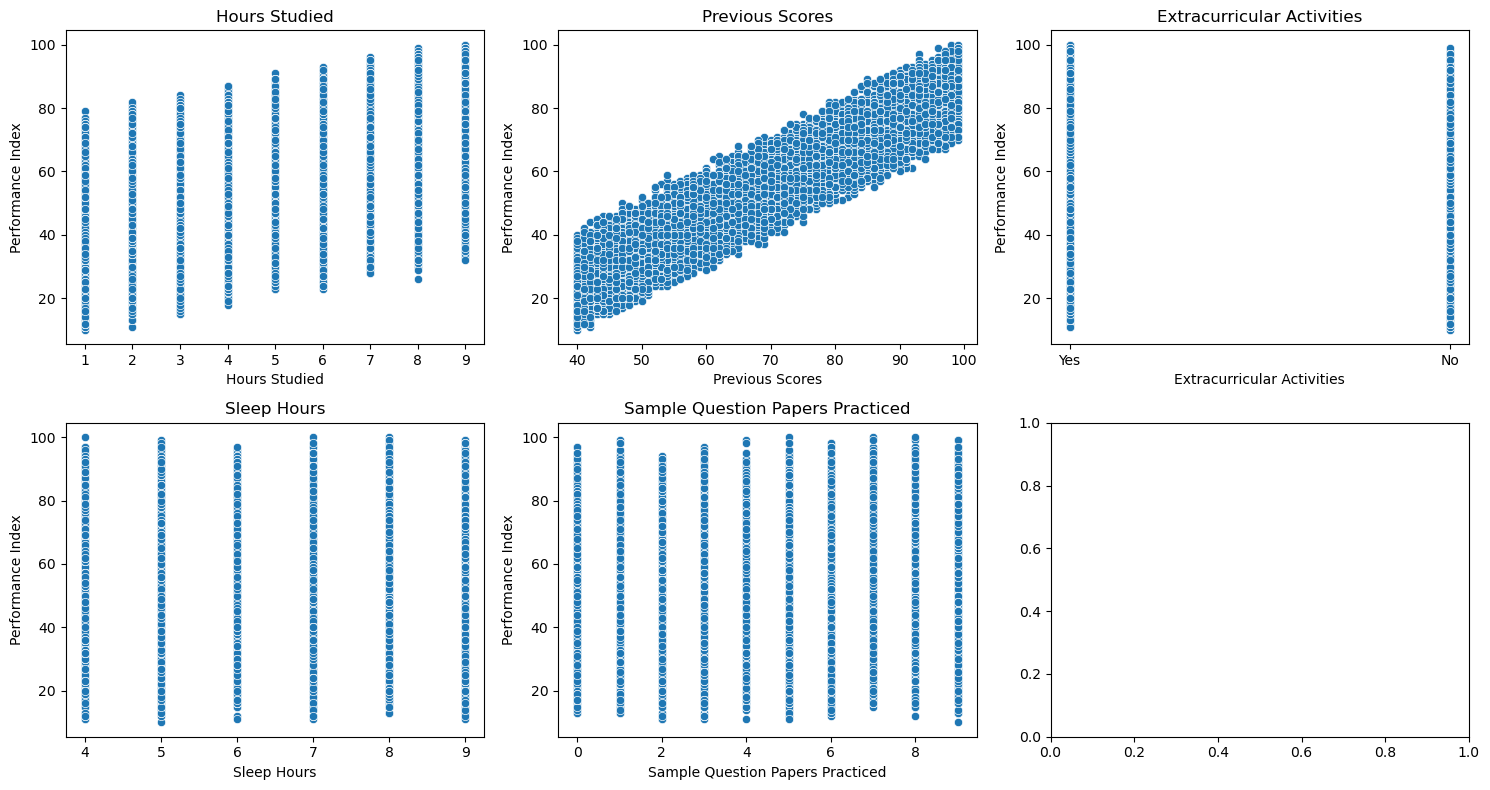
We start by analyzing data types, distribution, and visualizing feature relationships with the target variable.
Distributions
Scatter Plots vs Target
Correlation Heatmap
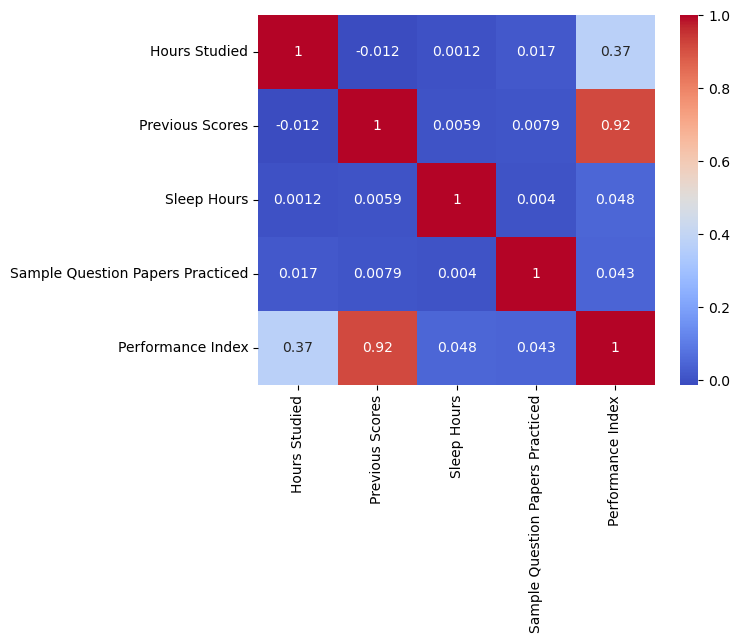
Insights:
- Previous Scores have a very strong positive correlation (0.92) with Performance Index.
- Hours Studied has a moderate positive correlation (0.37).
- No multicollinearity issues among features.
🧹 Data Preprocessing
Binary Encoding for Extracurricular Activities:
dataset['Extracurricular Activities'] = dataset['Extracurricular Activities'].map({'Yes': 1, 'No': 0})
Standardization for continuous variables:
from sklearn.preprocessing import StandardScaler

scaler = StandardScaler()
cols = ['Hours Studied', 'Previous Scores', 'Sleep Hours', 'Sample Question Papers Practiced']
dataset[cols] = scaler.fit_transform(dataset[cols])
✂️ Train-Test Split
from sklearn.model_selection import train_test_split

X = dataset.drop("Performance Index", axis=1)
y = dataset["Performance Index"]

X_train, X_test, y_train, y_test = train_test_split(X, y, test_size=0.2, random_state=13)
🧠 Model Fitting
from sklearn.linear_model import LinearRegression

model = LinearRegression()
model.fit(X_train, y_train)
Model Coefficients
print(pd.Series(model.coef_, index=X.columns))
Equation of the fitted model:
Y = β₀ + β₁·X₁ + β₂·X₂ + β₃·X₃ + β₄·X₄ + β₅·X₅
- X₁ = Hours Studied
- X₂ = Previous Scores
- X₃ = Extracurricular Activities
- X₄ = Sleep Hours
- X₅ = Sample Question Papers Practiced
📊 Model Evaluation
from sklearn.metrics import mean_absolute_error, mean_squared_error, r2_score

mae = mean_absolute_error(y_test, y_pred)
mse = mean_squared_error(y_test, y_pred)
rmse = np.sqrt(mse)
r2 = r2_score(y_test, y_pred)
Results:
- MAE: 1.622
- MSE: 4.144
- RMSE: 2.036
- R² Score: 0.989
📈 Residual Analysis
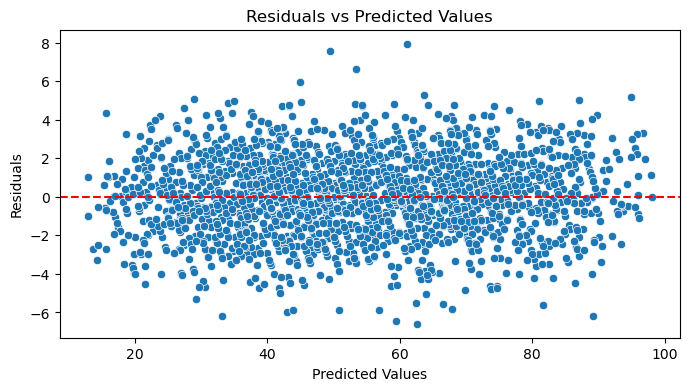
Residuals are evenly spread around 0 ; no pattern detected. Indicates assumptions of linearity and homoscedasticity hold.
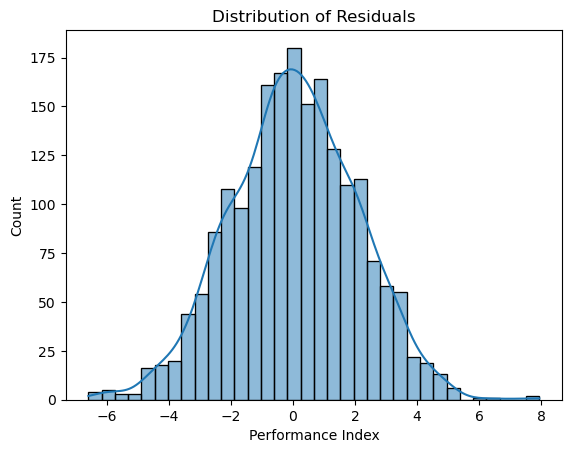
Residuals appear normally distributed ; supports the assumption of normality.